


Supporting Students’ Health in the Classroom and Beyond
By Darrin Nichols, MD, FAAFP, Chief Medical Officer, Coplin Health Systems
With the new school year settled in across the state, I often think about my patients as they return to the fall routines and all that entails. It’s also a time when many families have the added logistics around school that can make it difficult to get healthcare for their children. Rural West Virginia is a place where community is strong, but access to healthcare can be stretched thin by geography, transportation, and limited provider availability.
For many families, even routine care becomes difficult to access, and small issues can turn into larger ones simply because care was hard to reach. This is why bringing healthcare closer to where children already are is so important.
Why Bringing Healthcare Into Schools Makes Sense
From my perspective as a rural physician, schools can be a practical place to access healthcare. Children spend much of their day at school, so teachers and school nurses are often the first to recognize a health concern. When care is available on-site, families do not have to rearrange their entire day to address a minor issue.
In rural communities, a clinic visit can require hours away from work and school. School-based care reduces that disruption and helps children receive attention sooner. It also strengthens the connection among families, schools, and healthcare providers.
How the Telehealth Backpack Program Works
When the Telehealth Backpack Program was first introduced, I saw a possible solution to a familiar problem. Children need care, but the traditional path to receiving it is not always realistic for their families all the time.
The program uses secure technology and connected diagnostic equipment to link students with healthcare professionals. It allows concerns to be evaluated quickly, supports early intervention, andhelps parents understand the best next step for their child. As a family medicine physician, I know how much timing matters. Addressing a concern promptly can prevent a child from becoming more seriously ill or missing additional days of school.
What High-Quality Telehealth Looks Like
Parents often wonder whether a virtual visit can offer the same level of attention as an in-person appointment. In this program, it can!
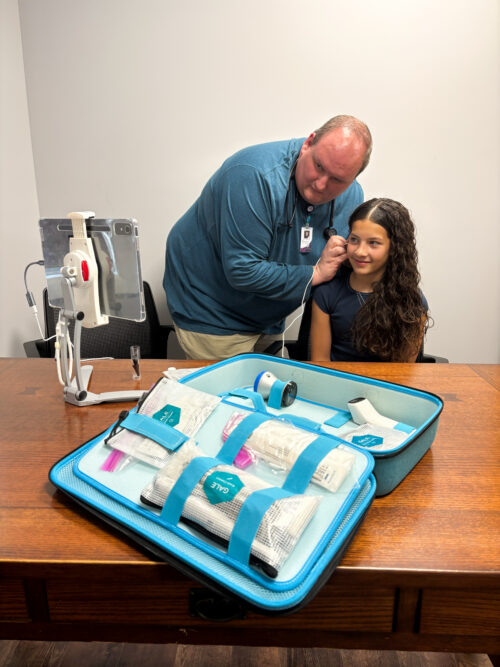
During a telehealth visit, the healthcare provider can talk directly with the student, observe symptoms, ask detailed questions, and use connected diagnostic tools to gather clinical information. Trained school personnel assist on-site, and parents and guardians can join the visit from wherever they are. They remain part of the conversation and can share concerns, provide history, ask questions, and hear the plan of care.
It’s important to know that telehealth does not change clinical standards for what we do as healthcare providers. Our responsibility is the same for every visit and an important part of using this tool is ensuring that the problem we are addressing is appropriate for evaluation by telehealth or if an in-person clinic visit would be best. We listen carefully, assess the information available, communicate clearly, and recommend the safest and most appropriate care. This is simply a tool that allows us to be helpful without requiring patients to travel to us for care, when it is appropriate.
The Telehealth Backpack Program in Real Life
What does this look like in practice? Here are two examples of how the Telehealth Backpack Program was able to bring care directly into the school.
- A teacher developed symptoms of an ear infection during the school day. Instead of leaving work and traveling to a clinic, she completed a telehealth visit during a break. Her symptoms were evaluated, a treatment plan was developed, and she picked up her prescription after work. What could have taken hours was resolved with minimal disruption to her workday and her students.
- In another case, a student with a medically complex condition had already missed significant school time. When the school nurse became concerned about whether the student’s symptoms could be safely managed at school, she connected with us through the program. Together with the parent, we determined whether the child needed a higher level of care or could remain at school. That timely support made a meaningful difference for a child already facing major challenges and time away from school.
These examples show how the program helps schools and families make informed decisions based on medical needs without having the added burden of logistics to get the care they need.
Seeing the Broader Impact of Care on Demand
Timely school-based care benefits everyone. Students receive attention earlier and miss fewer days. Parents and guardians can avoid unexpected trips to clinics and can stay involved in care without leaving work. Plus, they can have the peace of mind that an expert was able to assess their child and provide guidance on next steps. Teachers and school staff gain clinical support when concerns arise – and they can even use the program for their own health concerns. Communities benefit from earlier intervention and fewer emergency/urgent care visits for issues that could have been addressed sooner, which would have been less severe when first noticed.
When care is easier to access, children, families, schools, and communities all gain stability and support.
As This School Year Begins
I know that the barriers families face are still there; transportation challenges and demanding work and school schedules still shape daily life in rural communities. Schools will continue to support students with increasingly complex needs. Programs like the Telehealth Backpack are narrowing the care gap by addressing the realities families face. It’s an investment in children, schools, and community health.
My hope is that families see this program as a trusted pathway to care. It keeps parents and guardians involved, brings clinical support closer to their child, and helps ensure concerns are addressed at the right time and in a trusted setting.
As the school year begins, I encourage parents and caregivers at participating schools to learn about the program and complete the registration. Having access to timely care during the school day can make a meaningful difference when a need arises.
February 1, 2018
Coplin Welcomes Pediatric Physician
Dr. Cathy A. Dailey has joined our primary care staff as a pediatric physician. She is now seeing patients 18 and under at Parkersburg Family Care.
March 1, 2018
New Family Care Facility Opens in Parkersburg
Coplin Health Systems has opened a second family care clinic at 3705 Emerson Square in Parkersburg. For information, call 304.917.3530.
August 29, 2018
Coplin Health Systems Announces Departure of CEO, Derek Snyder, and Selection of Interim CEO
Coplin Health Systems and its Board are announcing that, effective September 7th, Derek Snyder, its CEO is departing the organization.